PJM Backup Generators: What You Should Know Now


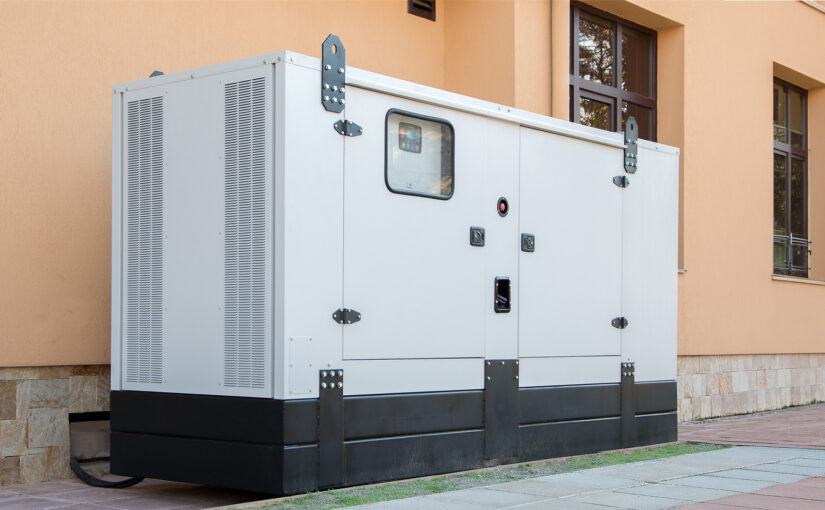
As PJM strives to meet rising demand, changes in regulations and policies have created new opportunities for commercial and industrial customers to earn demand response revenue by participating in the regional grid operator’s Emergency Capacity Program.
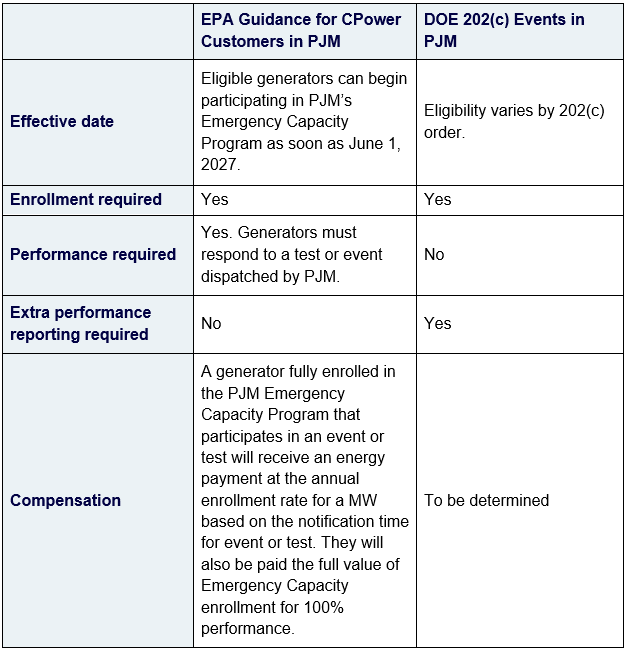
Demand response participation was previously limited to generators permitted for non-emergency usage, but two recent changes have also made some emergency generators eligible. The following blog post summarizes and compares the changes.
- EPA guidance allows CPower customers to enroll emergency generators in PJM’s Emergency Capacity Program for year-round demand response participation.
-
- What happened?
The U.S. Environmental Protection Agency issued guidance early this year, allowing CPower to enroll qualifying emergency generators in PJM’s Emergency Capacity Program under specific local reliability conditions.
Beginning with the 2027-28 demand response year on June 1, 2027, eligible generators may operate for up to 50 hours per year in the Emergency Capacity Program when PJM initiates qualifying localized dispatches. The guidance does not permit use of emergency generators for other PJM programs or peak shaving.
-
- What has changed?
Generators do not need to be classified as non-emergency generation or distributed generation to be eligible for enrollment in the PJM Emergency Capacity Program.
-
- What hasn’t changed?
Generators only permitted for emergency use still cannot participate in other PJM programs. Only generators classified as non-emergency or distributed generation can enroll in economic, energy or ancillary services markets.
-
- What generators are eligible?
Emergency generators located in Illinois, Ohio, Pennsylvania, West Virginia, or Virginia can participate, pending state and local permit review. Generators in other states covered by PJM and the District of Columbia are subject to additional criteria. CPower’s engineering team can confirm a generator’s eligibility based on its location and the criteria it must meet.
-
- What can generators do?
The EPA’s 50-hour rule allows generators to operate for up to 50 hours per year in non-emergency situations. In PJM, this allows them to participate in the Emergency Capacity Program, but not any other demand response programs.
-
- Is an enrolled generator required to be used?
A customer must use their generator and/or curtail their committed load for the PJM Emergency Capacity Program to be paid.
-
- Will a customer be paid for running their generator?
Yes. A customer will be paid their capacity payment and applicable energy payment under PJM measurements.
-
- How does participation work?
CPower customers can contact their account managers for enrollment information. If you would like to learn how CPower can turn your flexible energy into demand response revenue, call us at 844-276-9371 or visit CPowerEnergy.com/contact.
Customers and partners should contact CPower today to enroll for PJM’s 2027-28 demand response year beginning June 1, 2027.
- Temporary DOE orders permit PJM customers to use emergency generators in the Emergency Capacity Program on an as-needed basis.
-
- What has happened?
Separately, the U.S. Department of Energy has started authorizing PJM to call upon certain generation resources, including some behind-the-meter generation, to support system reliability when the grid operator expects very high demand. PJM may direct these resources to operate if they are needed to meet electricity demand across the region. A 202(c) alert authorizes a generator’s operation over any current emissions restrictions during the 202(c) event.
-
- What has changed?
Backup generation that wouldn’t normally qualify to participate in the PJM Emergency Capacity Program can do so when the DOE issues an emergency order under Federal Power Act Section 202(c).
-
- What hasn’t changed?
These are short-term, order-driven changes. They do not alter the terms of PJM programs or a customer’s underlying agreement with CPower.
Also, if a generator is already on CPower’s list of resources approved for demand response participation, a customer does not need to do anything different. A 202(c) order only applies to previously unapproved generation and helps emphasize the importance of using it to help the grid in critical circumstances.
-
- What generators are eligible?
A customer must tell CPower a generator will be available to operate under a 202(c) order so it can be registered for dispatch with PJM. PJM submits that list of generation assets to the US DOE for review and acceptance. Then CPower will tell the customer when an order has been issued. The DOE has issued several orders in 2026 in response to PJM requests.
-
- What can generators do?
Generation units with emission restrictions or other operating limitations may be used to respond to the expected load stress, shortage of electric energy, shortage of facilities for the generation of electric energy and other causes if PJM determines it needs more generation to meet anticipated electricity demand in its service territory. Any run hours under a 202(c) order will not be counted against limits on hours or emissions.
-
- Is an enrolled generator required to be used?
No. A 202(c) order permits a customer to run backup generation that wouldn’t normally qualify for demand response participation, but it does not require the resource to be used. However, it is recommended that the generator participate and operate as dispatched to help the grid avoid brownout or blackout conditions.
-
- Will a customer be paid for running their generator?
Yes. Compensation will be determined at a later date.
-
- How does participation work?
A customer must confirm they have a backup generator and can comply with a 202(c) order before one is issued, so CPower can register the generator for use in the PJM Emergency Capacity program during a 202(c) event. An account can be registered with as little as a voluntary, 0kW enrollment.
Then a customer must provide CPower with the location and the number of hours each unit ran when PJM called on the specified resources. Only contracted customers that have confirmed generator capability and have expressed a willingness to participate under a 202(c) order will receive related communications.
CPower customers can contact their account managers for more information on the EPA’s guidance and DOE 202(c) orders. If you are not a CPower customer but would like to learn more, please call us at 844-276-9371 or visit CPowerEnergy.com/contact.
Published by

